Article summary
David Stockman traces Ukraine’s regional fractures since 1991
In a text reproduced by Bruno Bertez, David Stockman explains that Ukraine’s regional fractures, inherited from the Soviet era, can be seen in elections since 1991.
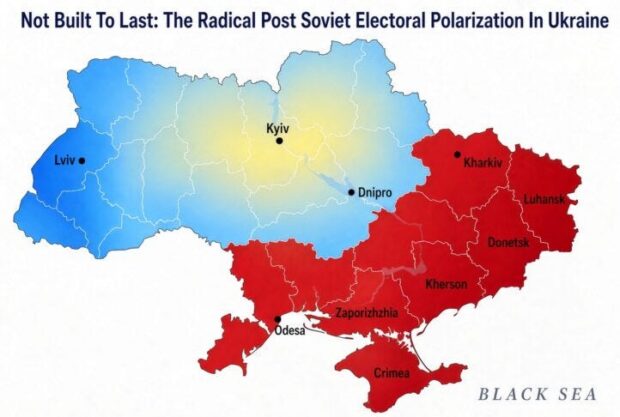
According to David Stockman, author of an analysis published on AntiWar.com, the Ukraine born in 1991 takes over the borders of the Soviet republic of Ukraine. He calls this construction an artificial entity, shaped by Soviet leaders for administrative needs. After the fall of the Soviet Union, it became polarized along regional and linguistic lines.
According to the author, the regions are divided into two blocs. The west and the center gave large majorities to candidates attached to Ukrainian and Western institutions. The east and the south, from Donbass to Crimea via Kharkiv, voted massively for a rapprochement with Russia and a greater status for Russian. At the national level, the scores remained close, while the regional results diverged.
The author recalls the history of these areas. Galicia and Volhynia lived for centuries under Poland-Lithuania then the Austrian Empire, with little affinity for communism and Russian culture. The east was shaped by the Tsarist Empire, and the two areas bear the marks of the Second World War. In 1991, Leonid Kravchuk won with 61.6% of the vote. In 2004, the second round saw Viktor Yushchenko win 52%, against 44% for Viktor Yanukovych.